


Get a PO Box. Use a VPN. Set your location to private. Block and move on.
If you've been a creator for any time at all, you've probably collected these tips here and there from other creators, like breadcrumbs. Someone in a Facebook group mentioned the PO box after something scary happened to a friend. Someone else suggested the VPN. A creator you follow posted a list of "safety tips" after a bad week. You might have even done a few of them.
The tips are great, they're not wrong...exactly. They're just not a real strategy. They're reactive by nature, not proactive. And when it comes to your safety, proactive is where it's at. If you wait until something bad happens, it's a much bigger headache to clean up than when you take action before.
The deal is... that the same skills that make you really fantastic at your job as a creator - the vulnerability, the consistency, the intimacy you build with strangers over time - are the exact skills that can attract someone who thinks the relationship you have is deeper than it is.
That means that the better you are at building an audience, the more you also attract people who can't tell a parasocial relationship from a real one. You can't build a relationship with the fans you want without also building a relationship with the ones you don't. That's the Parasocial Paradox. And it's a structural part of the creator economy.
So, ad hoc tips are great. But they can't actually solve the problem because structural problems need structural solutions. And, barring that, you need to understand the relationship dynamic with your audience enough that you, the creator, can manage it. Because if the system isn't going to fix it (and at least at the moment, doesn't seem like there's an incentive for the platforms to take on this responsibility)... it ends up landing on creators to figure it out.
What you need instead is a way of seeing your audience clearly enough to understand what's actually happening in it - and where the gaps in your protection are before something goes wrong.
That's what the Parasocial Spectrum is for.
Why a spectrum - and why it's different
Most advice for audience safety is built around incidents. Something happens - whether that's a threatening DM, an aggressive comment, a pattern of behavior that finally becomes clearer - and you respond to it. You get a category of behavior for what just happened → troll, stalker, harassment. You get a tip from another creator for handling it and then you move on.
But using this as a safety strategy has two pretty glaring problems.
The first is that it's reactive by design. It can only tell you what's already happened. By the time someone fits cleanly into a category, you've already lost most of your options to do anything useful - and the further things have escalated, the fewer options you have left.
The second problem is a little more unsettling - the reactive approach only works if the person you're worried about is giving you something to see. It assumes there's some visible behavior - a DM you can screenshot, a comment you can point to. But some of the most significant people in your audience are completely invisible to you. They've never commented, never sent a DM, never shown up in your analytics. They've just been watching, quietly gathering info, and building a picture of your life from everything you've shared. And you have no idea they even exist.
The Parasocial Spectrum is built around categories (ones you'll hopefully recognized), but it's not organized by incident type. It's about the nature of the relationship. The question isn't, "what did this person do?" It's "what does this person want from me - and has that shifted?"
Every position on the spectrum describes a type of relationship - what someone wants from you, how they understand that connection, and whether they're looking for something you've chosen to share or something you decided to keep private. The spectrum is a map of the full range of relationships in your audience, from the ones you're deliberately building to the ones you can't predict.
The spectrum makes movement visible in a way that looking at isolated incidents can't, because you're not waiting for a specific behavior to occur. You're watching for a shift in the nature of the relationship itself.
That shift - and the ability to see it before it becomes a problem - is what the spectrum is designed to show you.
The Parasocial Spectrum
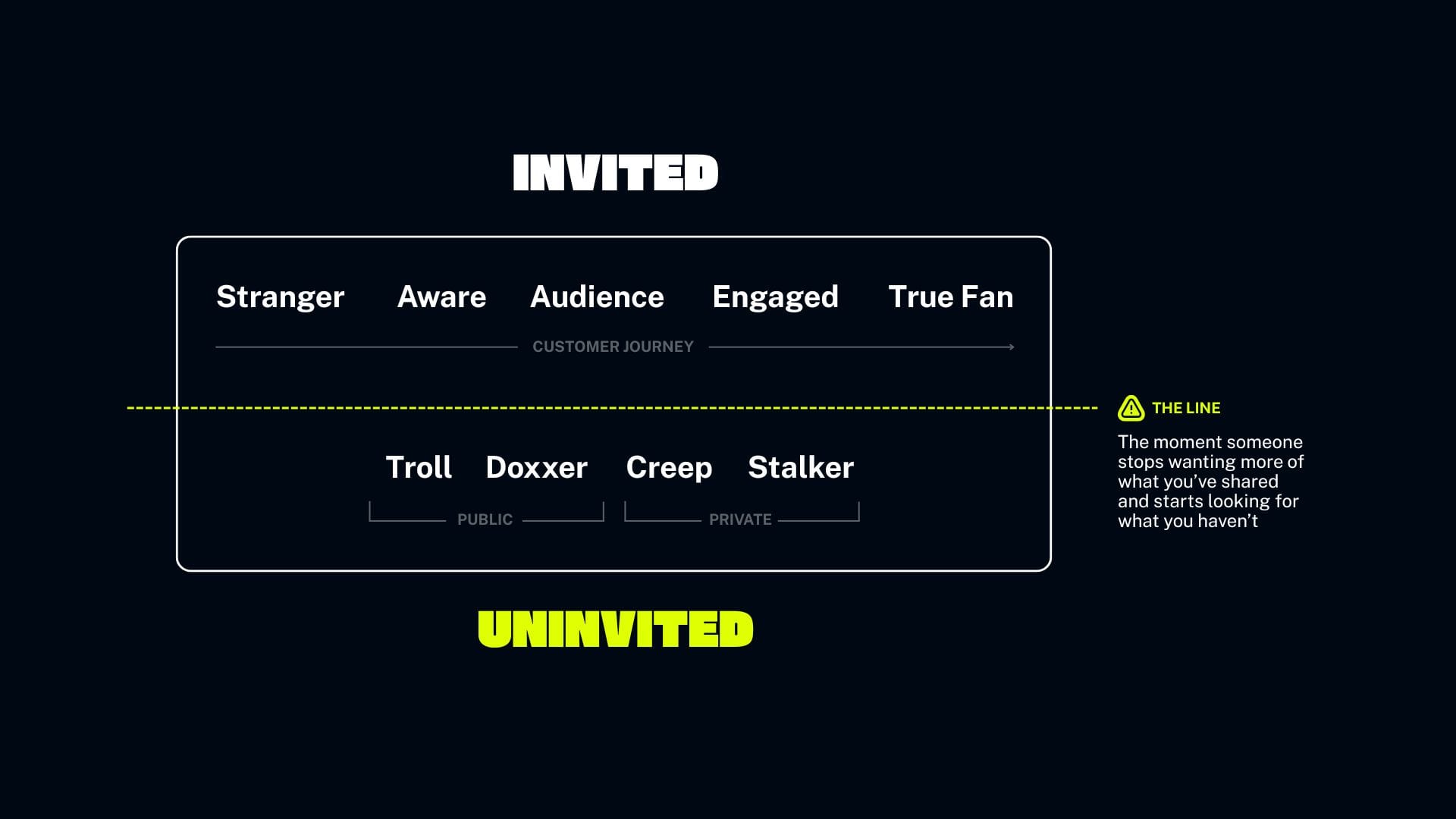
The Parasocial Spectrum runs from complete stranger to active threat with every type of audience relationship somewhere in between.
On the left side are the relationships you're building on purpose. You invited them in and you're curating their customer journey intentionally. Stranger, Aware, Audience, Engaged, True Fan. This is where the vast majority of your audience lives and it's where they'll stay.
On the right side, the relationships that have crossed The Line. Troll, Doxxer, Creep, Stalker. A small number of people, but the ones that matter for your safety.
And in the middle is The Line itself. It's the moment someone stops wanting more of what you've shared and starts looking for what you haven't.
A few things to understand about how the spectrum works before we get into the details. It's not a pipeline. People don't necessarily move through it in order, graduating from one stage to the next like some kind of reverse loyalty program. People jump. Someone can go from True Fan to Doxxer without a single warning sign. An Aware audience member can cross The Line and land somewhere serious without ever having shown their face.
It's not a crystal ball. You're not using this to predict where someone ends up. You're using it to understand where someone is right now - and to notice when something moves.
And it goes both ways - the spectrum describes how relationships can turn dangerous, but it also describes the healthy relationships that make your work worth doing.
The positive: the relationships you're building on purpose
Most of your relationships as a creator are built intentionally. That's your job as a creator - take someone who's never heard of you and turn them into a fan - someone who consumes everything you make, loves having your voice in their head and trusts you enough to buy from you. So, a huge chunk of your brain space is devoted to figuring out how to intentionally build those relationships at scale.
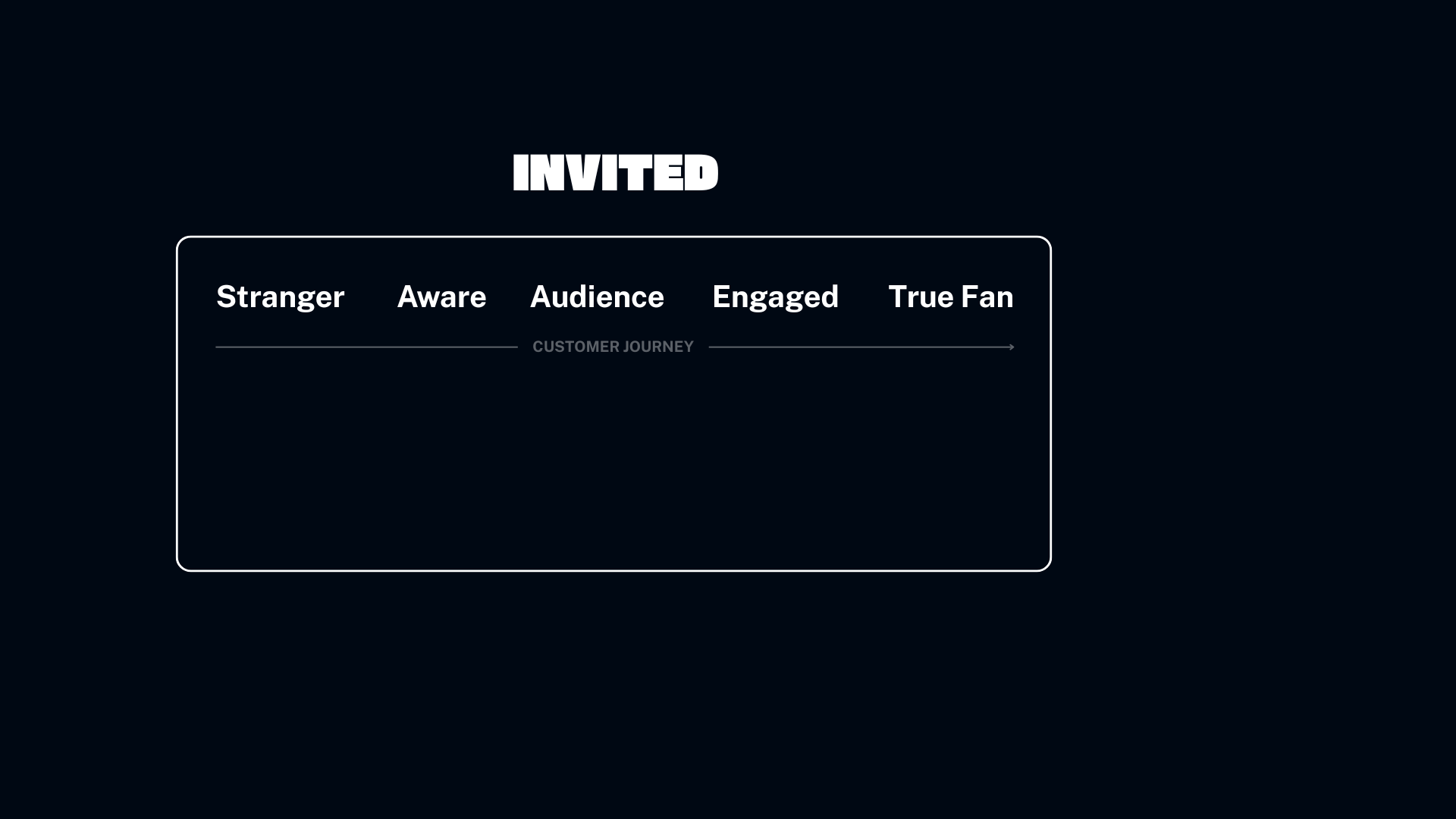
That intentional journey (sometimes called the customer journey) generally looks something like this:
Stranger. They have no idea you exist yet - everyone in your audience started here at some point.
↓
Aware. They've encountered you somewhere, whether that's a post, a recommendation, a search result. They know you exist - and they might come back, or they might not. Sometimes they're just lurking in the background - maybe they've been consuming your content but they've never left a comment, replied to an email or sent a DM.
↓
Audience. Regular consumers of your content who show up consistently. Usually you'll see some engagement from these folks - a like here, a comment there, a reply to a newsletter. They're part of your community in a real sense, even if you don't know their names.
↓
Engaged Fan. These are the people who make the work feel worth it. They comment thoughtfully, share your content, respond to your questions, show up to your lives. They're invested in what you're building. They tell their friends about you. They feel comfortable pushing back when they disagree and they celebrate when you win.
This a genuinely good relationship - there's still asymmetry in the relationship (they know you better than you know them) but they understand that. They're not confused about what the relationship is.
↓
True Fan. Kevin Kelly coined the idea of "1,000 True Fans" being what you need to find success as a creator, and it holds up. These are the people who buy everything you make, follow you across all your platforms, and evangelize you to anyone who will listen. The relationship is still one-way but their investment in you is real and the loyalty is deep.
The True Fan relationship is also where the spectrum starts to get complicated. Not because True Fans are dangerous (most aren't). But because the depth of investment that defines a True Fan can easily tip into something that looks a little bit closer to obsession. It's a fine line.
We'll get to that in a minute.
The Social Relationship Offramp
The spectrum isn't a conveyor belt - people don't automatically move towards deeper engagement, and they definitely don't automatically move towards being a threat. Most people stay somewhere in the Audience→Engaged Fan range for as long as they follow you.
But... there IS an offramp - and you're the one in control of it.
Parasocial relationships can morph into genuine two-way relationships at any point on the spectrum. You can decide that you have a fan that you want to try to build a real relationship with - a social relationship, instead of a parasocial one. Maybe that person who commented thoughtfully for two years ends up at the same conference and becomes a real connection. Someone who replies to your newsletter ends up becoming a collaborator or a friend.
The one-way relationship can become a two-way one if you want it to. But you're the one who chooses to build the relationship both ways - the audience member can't make that choice. It's worth naming explicitly because the spectrum isn't about treating your audience with suspicion, it's about seeing them clearly.
The Line
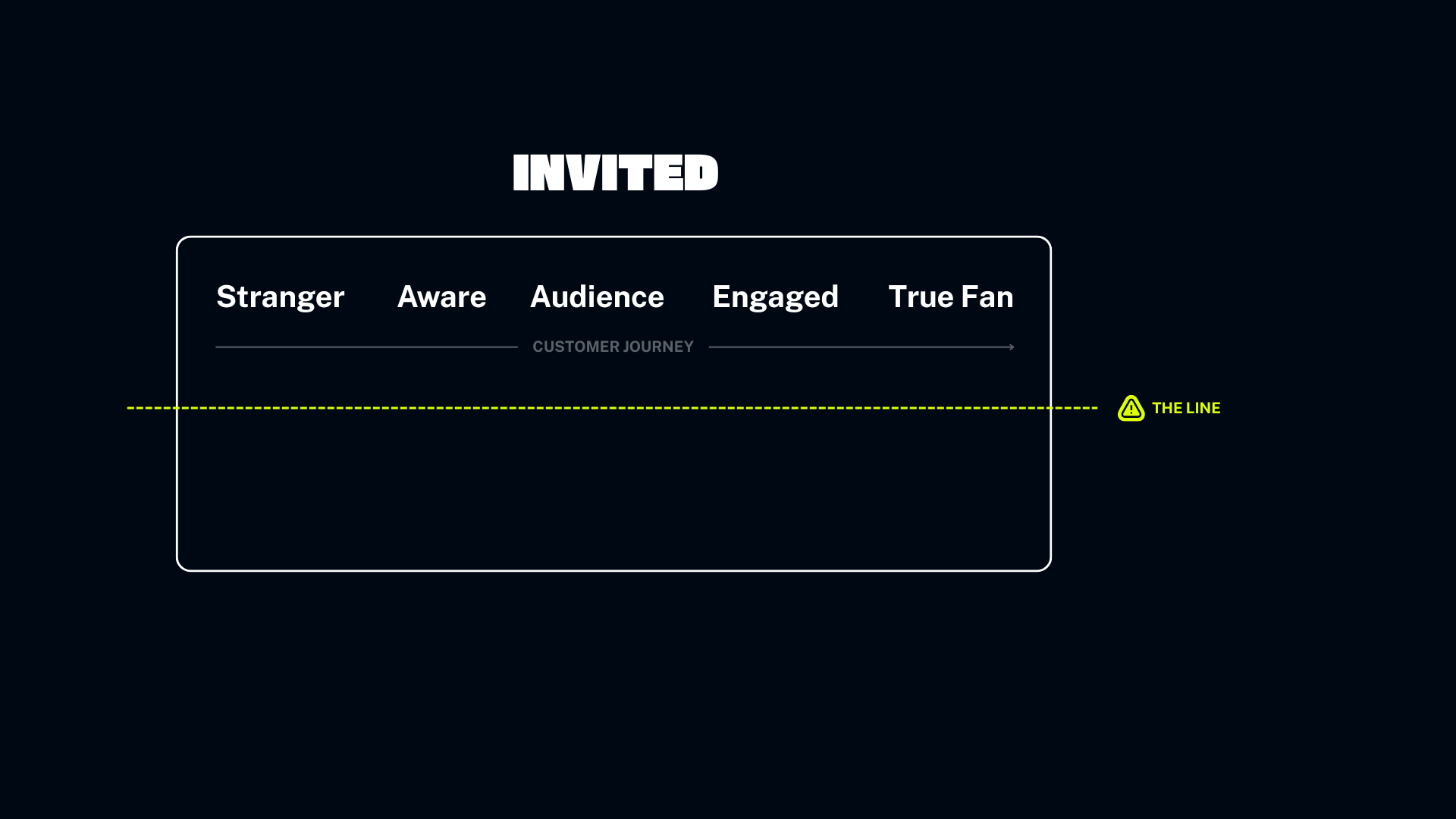
The moment someone stops wanting more of what you've shared and starts looking for what you haven't.
Everything on the left side of The Line is something you're building on purpose. Everything on the right side is something else.
The Line is the point at which someone's behavior stops being about your content and starts being about you. Not you-as-creator, but you-as-a-person. The physical you. The private you - the you that exists when the camera is off.
It can look like a lot of different things. An excited DM that crosses from "I love your work" into territory that feels uncomfortably personal. A comment that references something you mentioned once, months ago, that you'd forgotten you said. A question about where you live that has nothing to do with your content. A feeling (pay attention to it) that someone knows more about your life than you remember telling them.
Here's the thing about The Line... crossing it isn't always malicious. Some people do cross it on purpose and they know exactly what they're doing. But some people cross it because they're following this little thread of intimacy you built until it led somewhere you didn't intend, and they genuinely don't understand that the relationship isn't what they think it is. Think about The Engaged Fan who shows up at your event because they feel like they know you. The True Fan who tracks down your address because they want to send you something. They don't think they've done anything wrong - to them, the relationship is real.
But intent doesn't change the risk, and it doesn't change how you feel about it, either. The way you handle someone who knows they're crossing a line might be different from the way you handle someone who doesn't - but in both cases, the line has been crossed, and that matters.
The Line is also your best early warning signal. The further someone moves past it, the harder it is to reel it back in and protect yourself. The further they go, the more options you lose. That's why paying attention and being able to recognize the signs early is so valuable. Prevention is WAY easier than cleanup.
The unintentional end: when relationships cross The Line
But sometimes relationships do cross over The Line. You're in control of what you're sending out into the world, but you're not in control of what someone decides to do with that. And sometimes fans do cross The Line and become threats.
A few things to remember as we navigate this unintentional side of the spectrum:
- It isn't a pipeline - not everyone who crosses The Line starts out at a Troll and methodically works their way to Stalker. People jump, and they can exist in two places at once. A True Fan can become a Doxxer with just one incident, whether that's a perceived betrayal, a public callout, a brand deal that felt like selling out. An audience member who's been invisible for years can cross The Line and land somewhere serious without showing any signs. The absence of warning signs isn't the same as safety.
- Position on the spectrum is observable, but trajectory isn't always predictable. You're not trying to (or likely to be able to) forecast where someone ends up. You're watching for movement - any movement - past The Line, because movement is the signal.
- There's also an important divide on this side of the spectrum. Trolls and Doxxers are still operating in public space - they're performing for an audience, using your info as a weapon against your reputation. Creeps and Stalkers have left the public space entirely - they're not performing for anyone, they're focused on access to you. Those are genuinely different situations that call for different responses.
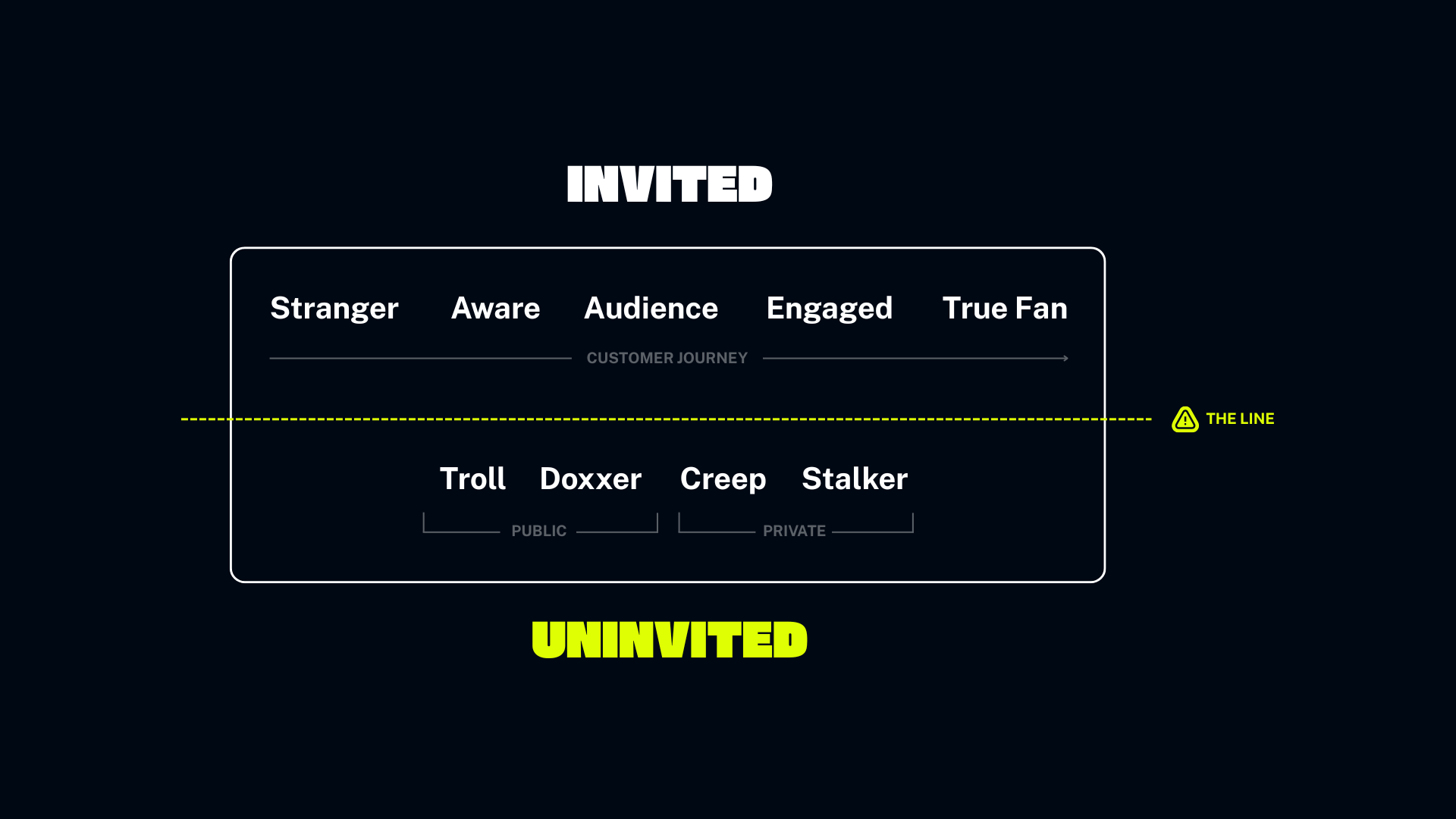
The unintentional end of the Parasocial Spectrum, past the line looks like:
Troll. They're still audience facing. The Troll wants a reaction and they want people to see them get it. They're performing disruption. It's genuinely unpleasant - harassment campaigns, pile-ons, relentless negativity - but the goal is still public. They're not necessarily interested in finding you, they're interested in damaging you in front of an audience.
An important note - trolls can become organized. A single person with a platform and a grievance can direct coordinated harassment from hundreds of people who individually might not ever cross The Line on their own. One person's bad day can become infrastructure.
Doxxer. The weapon shifts from words to information. A Doxxer's goal is to expose your private information - home address, phone number, family members, financial details - and publish it. Usually that's to mobilize others or damage your reputation. The goal is usually still public - they want the info out there where it can do harm. But now they're actively working to close the gap between your public life and your private one.
Creep. This is where that threat fundamentally changes - and where the public/private divide really matters. The Creep has left the public arena entirely - they're not performing for anyone. The fixation is on you, specifically, and it's private. We're talking about DMs, research, patterns of attention that might not show up publicly. In their mind, the relationship has become personal. You're not a creator they follow, you're a person they're focused on. This is quieter than a Troll and less visible than a Doxxer, which makes it harder to recognize. And sometimes easy to dismiss or brush off.
Stalker. This is someone who likely starts as a Creep, but becomes persistent, escalates and - at the extreme end - there's a physical component. The fixation has become consuming for them. The boundary between your public presence and your physical life has collapsed for them, even if you don't know it yet.
Now you've seen the full map. Most of your audience is on the left side - and they're there because you're awesome at your job. A small number off folks will cross The Line. Some will move slowly and some will jump. Some you'll see coming and some you won't.
The question isn't whether any of this is true. If you're intentionally building a platform, it just...is.
You can control what you put out in the world, but you can't control what someone decides to do with that. So, you need to assume there will be people who are going to cross The Line - and be in control of what they can actually do once they get there.
Going Unpublic
There's a version of this framework that leads to real bummer of a conclusion → your audience is a threat, visibility is a liability, and the safest thing you can do is disappear.
That's not the right conclusion (and if you did that, you'd be out of a job).
The spectrum isn't an argument against building an audience, it's a map of the full reality of what an audience is - the True Fans and the Engaged community and the folks who are just aware of you, and yes, the small number of people who cross The Line. Most of your audience is on the left side of that map. They're there because you're good at your job.
The goal isn't to go private. It's to go Unpublic.
Unpublic = The state of showing up fully in your public work while choosing exactly what stays private - and making sure it actually is.
Your platform, your content, your voice, your community - that stays public. That's the work, that's the job. What goes invisible is everything that bridges the gap between your public presence and your physical life. Your address, your family, your home. That's the information that can turn a parasocial relationship into a roadmap that heads right towards danger.
But if you focus on creating layers of protection around you, there's no information to get. That's the goal.
The spectrum tells you what you're dealing with. And going Unpublic is the strategy that lets you keep building - keep growing, keep showing up, keep doing the work - without handing anyone the keys to the parts of your life that were never part of the deal.

